
Anagram Maker
Find Every Possible Word
Our Anagram Maker is a fast, powerful tool built for anyone who loves wordplay. Whether you're solving anagrams for fun or chasing the highest score in a word game, this tool delivers results instantly.
Type any letters into the input box, and the anagram generator searches our full dictionary database to find every possible word. You can unscramble a single word, decode a phrase, or rearrange a longer string of characters — all in one place.
The solver supports up to twelve letters at a time. Use wildcards or blank tiles for unknown letters. Filter findings by word length, position, beginning, or ending. Sort results alphabetically or by point values. You can also set advanced options to narrow results by specific word criteria.
Our word list covers dictionary words across multiple languages — English, Danish, French, German, Italian, Norwegian, Portuguese, Spanish, Swedish, Bokmål, Nynorsk, and Brazilian Portuguese. Whether you play online games, offline games, board games, or multiplayer apps, this tool fits every game type.
From two letter words to twelve-letter combinations, the anagram finder uncovers hidden words fast. It supports consonant words, vowel words, and every letter combination in between. Use it for casual play, competitive play, or just a mental challenge on your own time.
Happy anagramming.
What Is an Anagram?
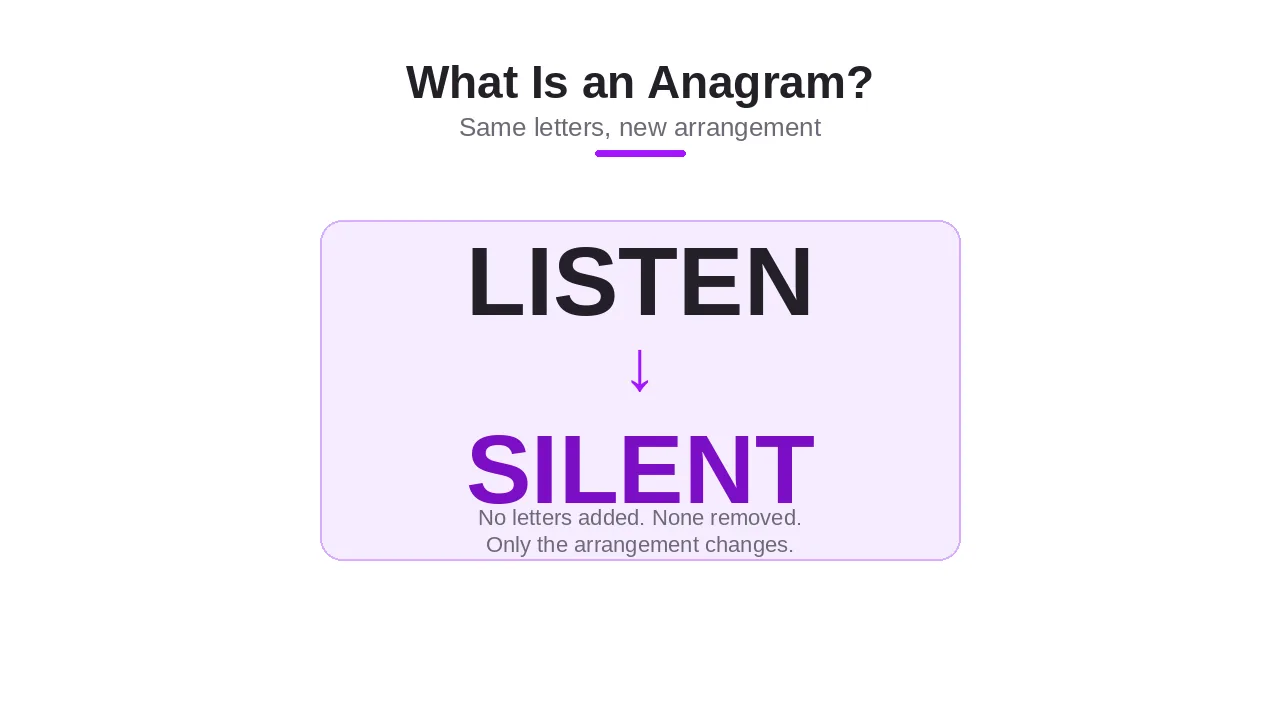
An anagram is a word or phrase formed by rearranging the letters of an original word or original phrase. Every letter in the original term gets reordered into an entirely different word combination. No letter is added. None is removed. The arrangement simply changes.
For example, the letters in one single word can be scrambled to reveal another word with a completely different meaning. That's the core of what makes anagrams such a fun linguistic puzzle.
Anagrams can be a single word or multiple words. They can come from a phrase, a full name, or even a birth name rearranged into something new. The text stays the same — just the letter arrangement shifts.
In the English language, anagrams appear in everyday use — from wordplay and brain teasers to puzzles, vocabulary games, and more. They test your knowledge of spelling, letter combinations, and the alphabet. They also reveal how many word formations hide inside a familiar string of characters.
Anagrams aren't confusing once you understand the definition. They're a natural part of language — one that rewards curiosity. The dictionary is full of hidden words waiting to be decoded.
Anagrams originated in ancient times. Over the centuries, they've grown into a relevant term across literature, games, and even code. Whether you're reimagining a phrase or decoding a vowel-heavy string, the result is always a new way to see language.
History of Anagrams
Anagrams have a long history. They originated in ancient times, where philosophers, poets, and theorists used them as a mystical ancient code. Early historians recorded them as far back as the 3rd century BC.
During the middle ages, writers used scrambling as a way to hide meaning inside their compositions. Full names and birth names were rearranged into pseudonyms — a practice that became a favorite among authors for centuries.
In the modern world, anagrams appear across popular culture — from crime fiction and mysteries to witty wordplay in literature. Writers still use scrambled original names as pen names or character names. Readers enjoy the challenge of spotting missing word clues hidden inside a phrase.
Anagrams have stayed relevant across every era of the English language and beyond. They've shaped how we think about terms, language, and the hidden structures inside text.
20 Cool Anagram Examples
Here are 20 cool examples that show just how interesting anagrams can be:
| Original Word / Phrase | Anagram |
|---|---|
| Dormitory | Dirty Room |
| Moon Starer | Astronomer |
| Listen | Silent |
| Debit Card | Bad Credit |
| Classroom | Thumps — wait, see below |
| Punishment | Nine Thumps |
| Astronomer | Moon Starer |
| School Master | The Classroom |
| Conversation | Voices Rant On |
| Election Results | Lies, Let's Recount |
| The Morse Code | Here Come Dots |
| Slot Machines | Cash Lost in 'Em |
| Eleven Plus Two | Twelve Plus One |
| Rose | Sore |
| Funeral | Real Fun |
| The Eyes | They See |
| Desperation | A Rope Ends It |
| Vacation Times | I'm Not As Active |
| Astronomers | Moon Starers |
| Dirty Room | Dormitory |
Each of these word pairs reveals a surprising number of connections. The letters are reordered into an entirely different meaning — yet every single letter is contained within the original. These examples discover just how much fun and knowledge hides inside familiar phrases. A single word or multiple words can reveal a hidden word you'd never expect. These are entertaining, and they show the true power of wordplay.
Where Are Anagrams Used?
Anagrams show up in more places than most people expect:
Word Games & Board Games
Scrabble, crossword puzzles, cryptic crosswords, and daily jumble all use anagram-style thinking. Wordle challenges players with guessing rounds and turns based on letter patterns. Puzzle games and trivia questions often include a cryptic clue built around scrambled letters.
Online & Offline Games
Mobile games use abstract and symbolic imagery with lateral thinking riddles. Card games and board game formats challenge players with correct guesses for scoring. Hangman figure games rely on guessing a secret word letter by letter, penalizing each incorrect guess.
Creative & Educational Use
Writers use anagrams to create a pseudonym, pen name, or character name. A username or nickname built from a full name is a common creative choice. In education, anagrams serve as a teaching tool and learning tool in the classroom. Kids games and family game formats use anagrams to build linguistic skills and artistic creativity.
Community & Competition
Online communities of players compete using anagram-based problem-solving. Connection-based games use visual associations and creativity to build on anagram knowledge.
What Is an Anagram Solver?
An anagram solver is a tool that takes a set of letters and quickly finds every possible word those letters can form. It searches a large database of pre-existing words and returns a full collection of solutions in seconds.
When you're stumped, struggling, or just confused about your next move, an anagram solver assists without any hard work on your part. It's an invaluable device for players who face a challenging rack of tiles and feel perplexed about what to play.
Some people feel tempted to call it a cheat sheet — but it's really just a word anagram aid. It helps you figure out which words are available from your letter tiles, display tiles you might miss, and uncovers word options from a single collection of letters.
Our solver isn't just one of many generators. It's an indispensable tool built around a full dictionary, multiple dictionaries including the scrabble dictionary, and a comprehensive wordlist. It pinpoint anagrams fast. It locates word options from any input, and the output includes everything from short two-letter words to long multi-letter solutions.
You can enter your letters into the entry field, plug in a wildcard for unknown letters, and let the solver decode what's possible. The array of results is loaded with options drawn from a curated selection of the generator free database.
Make Words From Letters
The core function of the tool is to make words from letters. Enter your scrambled letters — even random letters you pulled from a tile rack — and the word unscrambler gets to work instantly.
It handles jumble letters, multiple letters, and any letter combinations you throw at it. The jumble solver finds every single word hidden inside your entry. You can also change letters or reorder them to target a specific word.
Here's a quick example:
Letters entered: R, O, S, E
Target word results: rose, sore, roes, eros
Each result is a separate word formation from the same letter set. The unscramble function checks every possible word combination against the database. Word count, word building, and hidden word detection all happen automatically.
Whether you need a single word or multiple words, the unscrambler finds them all. Rearrange the letters to form new words, and you'll see just how many options are hiding in your letters.
How to Use the Anagram Solver
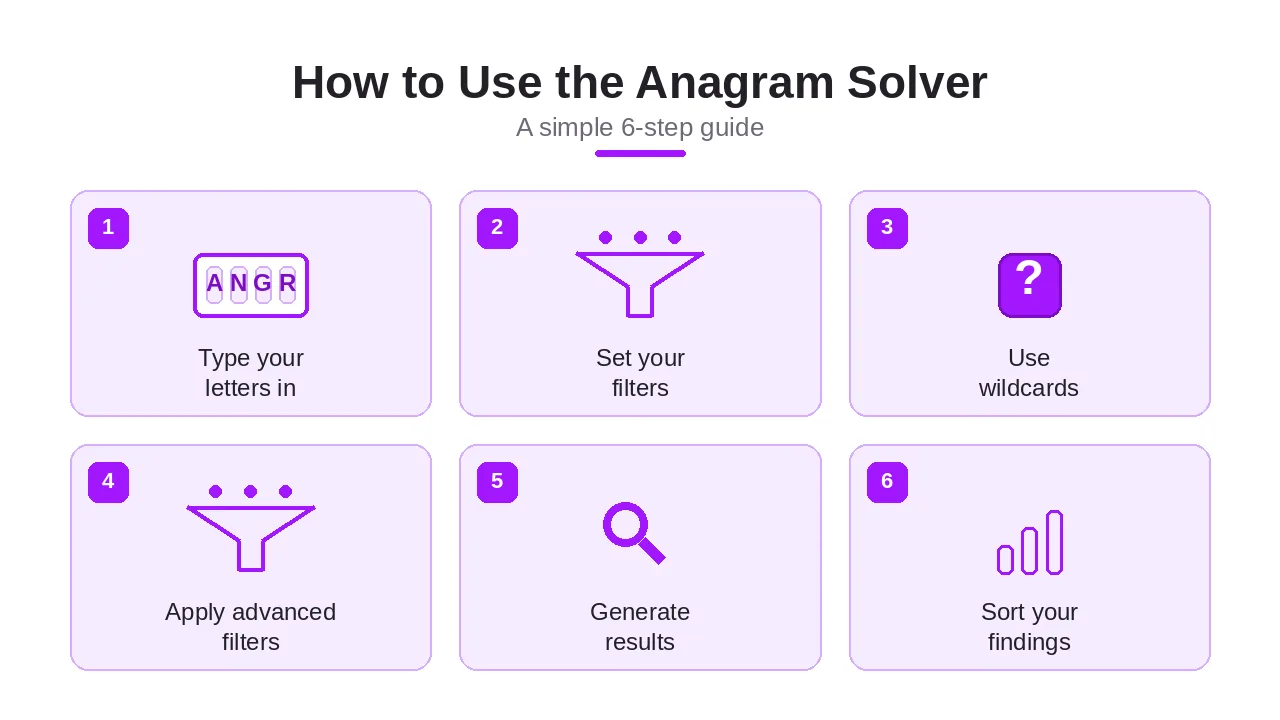
Using the solver is simple. Here's a quick guide:
- Type your letters into the input field (the input box at the top of the page)
- Set your filters — choose word length, position, beginning, ending, or anywhere in the word
- Use wildcards — enter a question mark (?) or blank tile for any unknown letter or extra letters
- Apply the advanced filter — set criteria like words start with, words end with, or contains particular letters
- Generate results — hit search and the tool will generate a new word list sorted alphabetically or by other available options
- Sort findings — reorder by length, point values, or open spaces on your board
The advanced settings let you filter by specific rules. You can narrow the output to words that start letters you specify, end letters you choose, or appear anywhere in the word. This makes it quicker to plug results directly into your game.
The tool handles up to 12 characters per entry. Blank tiles and wildcards count as unknown letter slots. Results show all available word combinations based on your criteria.
3 Simple Steps to Solve Any Anagram
If you're struggling with a mental challenge, follow these 3 simple steps:
Step 1 — Recognize prefixes and suffixes
Spot letter patterns at the beginning or end of your letters. Common prefixes and suffixes narrow the possibilities fast.
Step 2 — Pick the relevant letters
Pick out vowels and consonants. Systematically sort through the letter patterns to identify which combinations are most likely to form real words.
Step 3 — Reorder what's left
Rearranging the remaining letters becomes quicker once you've sorted the key ones. Use word tips from our tool to solve multiple words when things appear difficult.
These steps work for any string of letters. They turn a challenging jumble into a systematic process that boosts your strategy.
Anagramming Example
Here's a quick anagramming example to demonstrate steps clearly.
Original phrase: STUDY PHRASE
Step 1: Look at the beginning — spot common letter patterns.
Step 2: Alternatively, move less common characters to the side.
Step 3: Rearrange what's left and decode the hidden word.
When you study phrase structures and figure out the word count first, anagramming becomes easier. The string of characters is the same. Only the arrangement shifts. An original phrase rearranged differently can reveal something completely new.
Use our tool to solve any phrase you can't figure out manually.
Anagram Solver for Scrabble, Words With Friends & Crosswords
Word games like Scrabble, Words With Friends (WWF), and crossword puzzles all reward players who know how to work a tile rack. Our anagram solver is built to support all three.
The tool searches the full database for every word your letter tiles can form. It shows you the longest word options, the highest points possibilities, and the best arrangement for your available spaces on the game board.
Whether you're a novice just learning strategy or a seasoned expert chasing the highest score, the solver helps you accumulate points faster. It checks pre-existing words on the board, open spaces, and gives you a selection of moves ranked by point values and tile points.
| Game | Key Benefit |
|---|---|
| Scrabble | Finds highest-scoring words from your rack |
| Words With Friends | Shows best next move for available spaces |
| Crossword Puzzles | Decodes clues and fills missing words |
Veteran players know that wordgame strategy isn't just about luck — it's about knowing how to read your letter tiles and gain points from every move. Our solver gives you that edge by pulling tiles through the database and laying out your best options.
Scrabble Anagram Maker
The scrabble anagram maker is built around the official scrabble dictionary. It gives scrabble players the best possible score from every rack.
From your initial play, you can use it to find the longest word with the maximum amount of letter value. As the game progresses, it adapts — showing moves based on your current display tiles, blank tile options, blanks, and wildcard slots.
Use it to gain an early advantage. The more you use it, the more your arsenal of high-value words grows. It's not just a win tool — it's a weapon for anyone who wants to combine hard work with enjoyment and walk away with the highest score.
Words With Friends Anagram Finder
The words with friends anagram finder helps WWF players compete smarter. In this online word game, multiplayer games move fast — and knowing your next move before your turn arrives matters.
The finder shows every word available from your current tiles. It accounts for spaces on the board and open positions. Whether you're in the early drawing rounds or deep into guessing turns, it helps you score consistently.
Players in the WWF community use online apps and the mobile app to keep up with fast game pace. Our tool integrates into that strategy by giving you help whenever you need it — across all rounds and turns.
Crossword Anagram Solver
The crossword anagram solver targets crossword games specifically. Crossword puzzles often include a cryptic clue or a cryptic missing word that requires decoding. This puzzle solver handles that.
Enter the relevant letters you know, set the length and difficulty, and the tool does a full dictionary lookup plus definitions lookup. It finds shorter terms and longer options equally well. Decoding crossword word problems becomes much easier when you have a solver pulling from the full database.
Whether you're working through casual crossword games or trying to master crossword puzzles at an expert level, this tool makes it faster.
How to Solve Anagrams: Strategy Tips
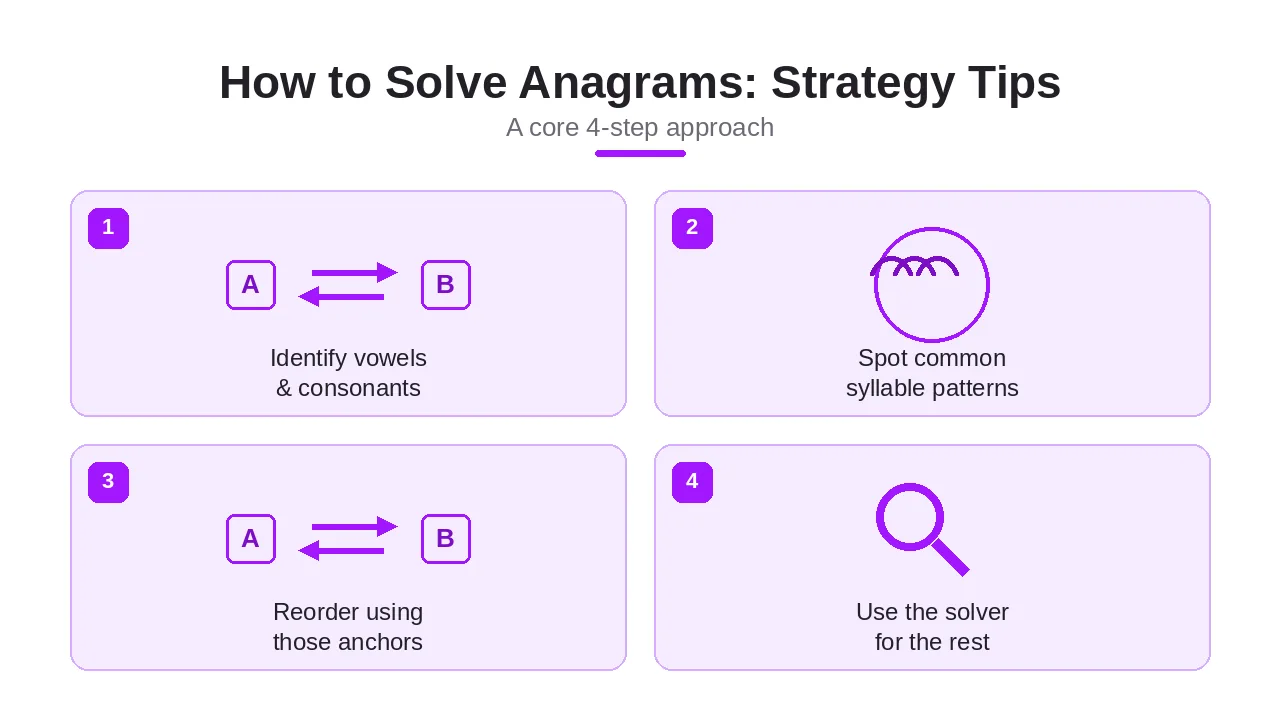
A good strategy makes anagram-solving faster and less stressful. These tips work whether you're brainstorming casually or competing for points.
Start by recognizing patterns. Your mind naturally spots familiar letter combinations — use that. Then arrange the letters differently until something clicks. Decoding becomes more systematic when you follow a clear set of rules.
Here's the core guide:
- Identify vowels and consonants first
- Look for letter sets that form common syllable patterns
- Reorder the jumble using those patterns as anchors
- Use the solver to handle what you can't figure out manually
Utilizing these steps builds skills over time. It also reduces anxiety when you're faced with a challenging letter set. With assurance comes quicker wins and better chances of winning overall.
Step 1: Recognize Common Prefixes and Suffixes
Start with Step 1 — recognize common prefixes and suffixes.
Look at your letters and ask: do any of these form a prefix or suffix I recognize? Common ones in the English language include:
- Prefixes: UN-, RE-, PRE-, IN-, DIS-
- Suffixes: -ING, -ED, -TION, -LY, -ER
Spotting these word patterns at the beginning or ending of your letter set narrows the field fast. It improves your spelling accuracy and vocabulary understanding by revealing the relevant term hiding inside the scramble. Focus on start letters and end letters first.
Step 2: Pick Them Out
Step 2 is to pick them out.
Once you've spotted the prefixes and suffixes, pick the relevant letters and set them aside. Then look at what remains. Focus on:
Vowel words — are there enough vowels to build something?
Consonant words — do the consonants form a recognizable cluster?
Two letter words — can any pair form a valid short word?
This selection process narrows the array of letter combinations. You're not looking for the longest word right away — you're looking for any hidden word that fits. The particular letters you pick first shape every word choice that follows.
Step 3: Rearrange the Letters to Form New Words
Step 3 is to rearrange the letters to form new words.
Take what's left after Steps 1 and 2. Start rearranging them. Try different arrangement options — reorder from left to right, then right to left. Create new word variations by shifting one or two letters at a time.
Look for multiple words if a single word isn't forming. Sometimes the best solutions come from splitting the letters into two groups. The tool gives you word choices instantly if manual rearranging isn't working. Use it to solve and confirm your options.
More Tips to Solve Anagrams
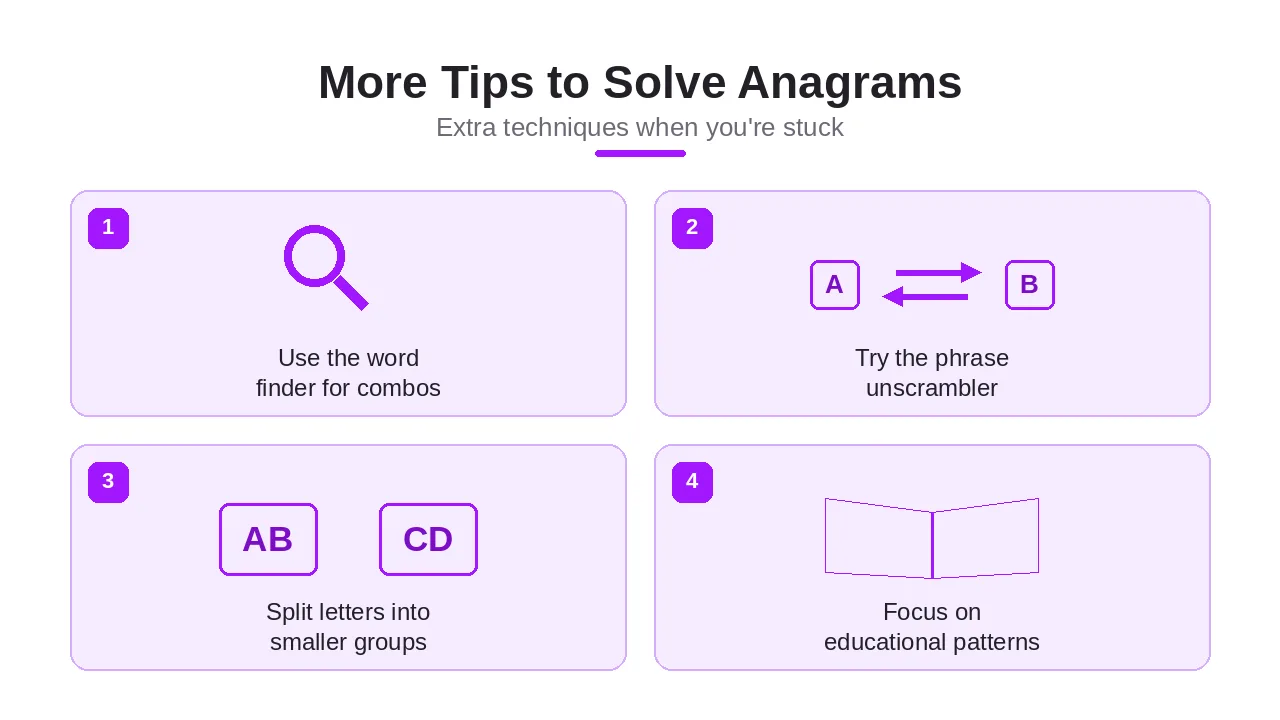
Sometimes the standard approach doesn't work. When you're confused or perplexed and the brain game feels too challenging, try these extra word tips.
Think of this as your personal cheat sheet — not for cheating, but for working smarter. Attempting to solve anagrams without any structure is harder than it needs to be. These tips turn downtime into a fun activity and keep the mental exercise productive.
- Use the word finder to search for specific letter combos
- Switch to the phrase unscrambler for multi-word puzzles
- Break your letters into smaller groups and unscramble each group separately
- Focus on educational patterns — unscrambling builds vocabulary and spelling skills over time
These tools together give you a full system for solving multiple words at once. The entertainment value stays high, and the learning is built right in.
Word Unscrambler
The word unscrambler handles scrambled letters of all kinds — daily jumble entries, random letters from a game, or any jumble letters you're stuck on.
Enter your letters and set the letter count or word length. The unscrambler returns a full word list sorted alphabetically or by other options. Results include every common word and hidden word your letters can form.
Findings are organized clearly so you can scan the word lists fast. Whether you need one result or twenty, it's all there.
Phrase Unscrambler
The phrase unscrambler works on longer puzzles. When you have multiple words in an original phrase, or a longer string of text made of many characters, this tool helps you study phrase structure and decode the full thing.
Enter the full phrase. The tool rearranges and reorders across word combinations to solve what's hidden. It pulls every possible rearranging option and presents them clearly. Decoding a multi-word phrase is no longer a guessing game.
More Anagram Solver Features
Beyond the core solve function, our tool includes a full set of features. Advanced options and advanced settings let you customize every search. Set criteria using the advanced filter. Adjust settings to narrow the database results or expand them.
The tool generates results within the upper limit generated for each entry. You can link to specific result pages or list outputs for later use. We value your feedback — use the contact page to send suggestions about your experience. Our goal is to keep improving the tool based on what users actually need.
This is a powerful tool designed around real usage — not a generic generator.
Word Definitions
Every result comes with a definitions lookup. Click any word to see its full dictionary definition, meaning, and usage in everyday life.
This feature helps you learn new terms while you play. It builds understanding of English words you might not have used before. Over time, your vocabulary grows and your language becomes more eloquent. Knowledge built this way sticks — because you find the word yourself, then immediately learn what it means.
Words by Length
Sort results by word length at any time. Filter from two letter words all the way up to twelve letters. The longest word your letters can form appears at the top when sorted by length.
You can also sort to show shorter words first — useful when you need to fit a word into a tight board space. The letter count and available options are always visible, so you stay in control of your results.
Word Finder
The word finder is built to search anagrams with precision. It locates word options fast, pinpoints anagrams based on your criteria, and uncovers word results from the full collection in our database.
Set a target word length, filter by specific word criteria, and the finder narrows the selection down immediately. The results reveal a surprising number of options — even from short letter sets. Use it to discover words you didn't know were hiding in your letters.
Why Play Anagram Word Games?
Word games are engaging, and there's a real reason why so many players keep coming back. They're fast-paced, mentally rewarding, and fun for everyone — from kids to adults.
Whether you're playing a classic word game with family members or competing in a digital game online, the benefits are real. You accumulate points, boost vocabulary, build spelling skills, and sharpen your word knowledge — all while enjoying the entertainment.
Word games connect community members across all ages and abilities. A novice learns something new every round. A seasoned expert finds new ways to win. The competition keeps everyone ahead of where they started.
Whether it's a board game, a family game, a brain teaser, or a brain game on your phone, the English language has more to offer than most people realize.
Discover Words You've Never Heard Of
Every game is a chance to discover words that are new to you. The dictionary is full of gems — rare English words that are perfectly valid in gameplay but rarely used in everyday life.
Our tool opens up those possibilities. It functions as a learning tool and education resource — not just a game aid. The more you play, the more relevant your word knowledge becomes. Understanding what a word means adds real value beyond the score.
Improve Your Knowledge of the English Language
Playing anagram games builds your language skills over time. You improve vocabulary, spelling skills, and word knowledge with every round. You start to recognize definitions, understand meaning, and use synonyms more naturally.
Our tool also supports multilingual play. Beyond English, it covers Danish, French, German, Italian, Norwegian, Portuguese, Spanish, Swedish, Bokmål, Nynorsk, and Brazilian Portuguese. Each language has its own vowel, consonant, and syllable patterns — and the tool handles them all.
Play Anywhere, Anytime
Our tool works across online games, offline games, and mobile game formats. Whether you're using online apps on a commute or playing casual games during downtime, it's always ready.
There's no fixed space or time requirement. Switch between competitive play and casual play freely. Try a quick game type during a break, or run full turns in a longer session. The tool fits around your schedule — not the other way around.
Suitable for All Ages and Abilities
Anagram word games are suitable for all ages and abilities. A novice can start with short, simple words. A veteran can push for master-level scores. An expert can challenge themselves with longer, more complex puzzles.
It works as a kids game, a family game, or a solo challenge. The community spans every skill level. Everyone finds value — whether the goal is fun, assurance in spelling, or the enjoyment of a good challenge. Every player belongs here.
FAQs
What is an Anagram Maker?
An Anagram Maker is an online tool that takes a string of letters and rearranges them to find every possible word hidden inside. It uses an extensive dictionary database to generate valid words instantly across multiple languages.
How does the Anagram Solver work?
You type your letters into the search field, apply optional filters (such as word length or start/end letters), and hit generate. The solver compares your letter combinations against dictionary records and displays all matching words sorted by length, points, or alphabetical order.
Can I use blank tiles or wildcards?
Yes. You can enter a question mark (?) or blank tile symbol for any unknown letter. The solver will automatically test all vowel and consonant options for that slot to find valid words.
Does this tool support Scrabble and Words With Friends?
Absolutely. The tool includes official Scrabble dictionary support and scoring metrics, making it ideal for finding high-scoring moves and solving tile racks in Scrabble, Words With Friends, and crossword puzzles.
Is the Anagram Maker free to use?
Yes, 100% free with unlimited uses. No registration, login, or installation is required to solve anagrams and make words from letters.